Are Mirrors Difficult to Cut? A Guide to Mirror Cutting and Glass Cutting
Are Mirrors Difficult to Cut?
Mirrors are not always difficult to cut, but the process requires care. A small mirror made from ordinary, non-tempered glass may be relatively straightforward to cut with the correct tools. However, larger mirrors and thicker glass require more control and experience.
When Should You Hire a Professional to Cut a Mirror?
Contact Us!Cutting a mirror might look simple, but getting a clean, straight edge takes the right tools, careful technique, and some experience. While small, ordinary mirrors can sometimes be cut by experienced DIYers, larger mirrors, thick glass, and specialty mirrors can be much harder to handle.
In this guide, you’ll learn why mirrors can be difficult to cut, how glass cutting works, what tools are needed, and when it’s better to ask a professional for help. If you need a mirror cut to size for your home or business, understanding these basics can help you avoid damaged glass and unnecessary costs.
Are Mirrors Difficult to Cut?
Mirrors are not always difficult to cut, but the process requires care. A small mirror made from ordinary, non-tempered glass may be relatively straightforward to cut with the correct tools. However, larger mirrors and thicker glass require more control and experience.
The biggest challenge is getting a clean break without cracking the mirror in the wrong place. Unlike wood, glass cannot simply be sawn through with ordinary tools. Instead, a glass cutter creates a shallow, controlled line on the surface. The glass can then be separated along that line.
Even when you follow the correct technique, mistakes can happen. Applying too much pressure, scoring the surface more than once, or trying to break the glass unevenly can cause unwanted cracks. The reflective coating on the back of the mirror can also be damaged if the glass breaks incorrectly.
If you only need a small mirror cut, DIY mirror cutting may be possible with the right preparation. For large, valuable, or unusually shaped mirrors, a professional glazier can help you get a cleaner result while reducing the risk of injury.
How Does Mirror Cutting Work?
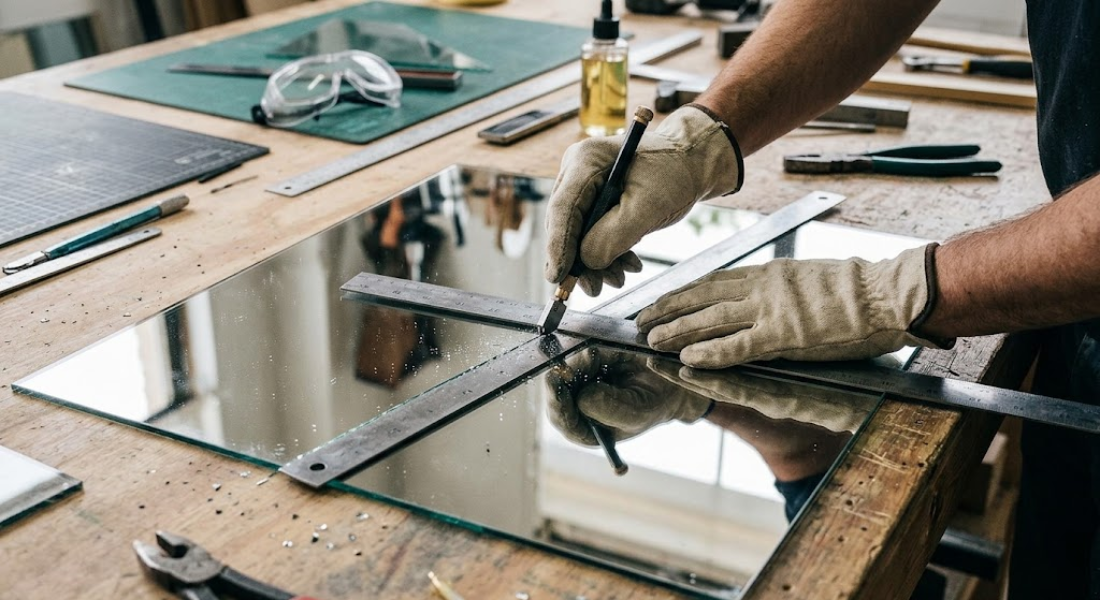
Mirror cutting works by creating a controlled score on the glass surface. A glass cutter uses a small cutting wheel to make a shallow line that helps the glass separate along a chosen path.
The process is different from cutting through a solid material. The cutter does not remove a strip of glass. Instead, it creates a tiny surface flaw that guides the break when pressure is applied correctly.
Before starting, the mirror must be placed on a flat, stable surface with enough support underneath. The glass should be clean, and the cut line should be measured and marked carefully. A straightedge can help guide the cutter when a straight cut is needed.
After scoring, the glass is separated using a suitable technique, depending on its size and thickness. The goal is a clean break along the score line, not a forceful snap that sends cracks in different directions.
Remember that not every mirror can be cut this way. Tempered mirrors, for example, cannot be safely cut after tempering because the internal stresses cause the glass to break into many small pieces. Always identify the glass type before attempting to cut it.
What Tools Do You Need to Cut a Mirror?
Having the right tools makes mirror cutting easier and helps reduce the chance of damaging the glass. A basic setup for suitable, non-tempered mirror glass includes a glass cutter, a straightedge, a stable work surface, and protective equipment.
A handheld glass cutter typically has a small cutting wheel made from a durable material, such as carbide. The wheel creates the score that guides the break. A straightedge helps keep the cut line straight, while a suitable glass-cutting lubricant may help the wheel move smoothly, depending on the cutter manufacturer’s instructions.
You should also prepare safety equipment. Wear eye protection and cut-resistant gloves suitable for handling glass. Keep other people away from the work area, and make sure there is enough space to handle the mirror without bumping into objects.
Some people use pliers designed for glass, often called running pliers, to help separate glass along a score. These tools require practice, and the correct technique depends on the type and size of the glass.
Avoid using ordinary household pliers, knives, or improvised cutting tools. They are not designed to create a controlled glass score. If you lack the proper equipment or experience, having a professional cut the mirror may be safer and more cost-effective.
Does a Thick Mirror Take Longer to Cut?
A thick mirror can be more difficult to cut because it requires greater control during scoring and separation. The thickness affects how the glass responds to pressure, and a technique that works on a thin mirror may not work as well on a thicker one.
Thin glass may separate relatively easily when the score is made correctly. Thicker glass can require specialized tools, additional experience, and more careful support. A small mistake can result in a broken corner, an uneven edge, or a crack that extends beyond the intended cut.
The size of the mirror also matters. A large mirror can be awkward to handle, even if the glass itself is not especially thick. Its weight and flexibility make proper support important throughout the process.
If you’re cutting heavy mirror glass, don’t assume that applying more force will produce a better result. Excessive pressure can cause the glass to break unpredictably. Some glass products also require special handling because of their construction or treatment.
For thick or oversized mirrors, a local glass professional can assess the material and determine the appropriate cutting method.
How Do You Score a Mirror Without Breaking It?
Scoring is one of the most important parts of mirror cutting. A good score helps guide the break, while a poor score can lead to cracks and wasted material.
First, make sure the mirror is clean and fully supported on a flat workbench. Measure the desired dimensions and mark the cut line accurately. Position a straightedge along the line to guide the glass cutter.
The cutter should be suitable for the glass thickness and used according to its manufacturer’s instructions. The goal is to create one continuous, consistent score rather than repeatedly tracing the same line. Pressing really hard is not the answer; too much force can damage the glass or produce an uneven score.
Once you’ve scored the surface, avoid dragging the cutter back and forth over the same line. Repeated scoring can create additional flaws that make the break less predictable.
It is also important to remember that the reflective coating on the back of the mirror is separate from the glass itself. Cutting the glass incorrectly can damage both the edge and the coating.
If the score looks uneven or the glass begins to crack unexpectedly, stop rather than trying to force the break. A damaged mirror may no longer be safe to handle.
How Do You Get a Clean Break Along the Score Line?
Getting a clean break depends on the quality of the score, the glass type, and the way the mirror is supported. Even a properly scored mirror can break incorrectly if pressure is applied unevenly.
For suitable glass, experienced users may use a purpose-made glass-cutting method to separate the piece along the score. The technique should match the mirror’s thickness and size. Forcing the glass by hand or trying to snap a large mirror without adequate support can cause sudden breakage.
Avoid placing your hands near the intended break or using your fingers to force the two sides apart. Small glass fragments can be difficult to see, and sharp edges can cause serious cuts.
If the mirror begins to split away from the intended line, stop handling it and keep others away from the area. Do not attempt to rescue the cut by applying additional pressure.
A clean break is easier to achieve when the glass is suitable for cutting and the work is performed with the correct tools. However, there is no guarantee that every mirror will separate perfectly, especially if it has scratches, existing damage, or an unsuitable construction.
For an expensive mirror or a cut that must fit precisely, professional glass cutting is often the better choice.
Can You Cut Any Type of Mirror?
No. Not every mirror can be cut safely, and identifying the glass type is an essential first step.
Ordinary annealed mirror glass is often suitable for professional cutting. Its glass surface can be scored and separated using the appropriate technique. However, tempered glass is different. It has been heat-treated to increase its strength, and cutting or scoring it after tempering can cause the entire pane to shatter.
Laminated glass mirrors and specialty products may also require different equipment and handling procedures. The reflective backing, protective films, and other layers can affect how the material should be processed.
An old mirror deserves extra care as well. It may have damaged edges, deteriorating backing, hidden cracks, or an unknown glass type. These problems can make cutting less predictable.
Never assume that a mirror is safe to cut just because it looks like ordinary glass. If you cannot identify the product, ask the manufacturer or a qualified glass professional before attempting any work.
What Are the Most Common Mirror-Cutting Mistakes?
One of the most common mistakes is using too much pressure while scoring. People often assume that a deeper line will make the glass easier to break. In reality, an inconsistent score can increase the chance of an unwanted crack.
Another mistake is scoring the same line repeatedly. A glass cutter is designed to create a controlled score, not a groove like a saw. Repeating the pass can damage the surface and make the break less predictable.
Poor support is another problem. If part of the mirror hangs over the edge of a table or workbench, the unsupported section may flex and break in the wrong place. The mirror should be supported appropriately for the cutting method and its dimensions.
Incorrect measurements can also waste material. Always check the required dimensions before marking the cut line, and account for the fact that cutting glass is not the same as removing material with a saw.
Finally, many people underestimate the danger of handling the cut edge. Even a mirror that separates cleanly can have sharp edges, while a chipped or jagged edge may be particularly hazardous.
If you are unsure about the material, tools, or technique, stopping before the mirror breaks is better than risking an injury or ruining the entire piece.
How Can You Handle and Finish a Cut Mirror Safely?
Glass can remain dangerous even after a successful cut. The edges of your mirror may be sharp enough to cause serious cuts, so careful handling is essential.
Wear appropriate eye protection and cut-resistant gloves when handling the glass. Keep the mirror supported, avoid twisting it, and do not lift it by a newly cut edge. Larger pieces should be handled with suitable glass-handling equipment and help from another person when necessary.
Small fragments and scraps should be collected carefully using appropriate tools. Never pick up tiny shards with bare hands. Place broken glass in a suitable, clearly marked container so it cannot injure someone handling ordinary waste.
A cut edge may need professional edgework, such as grinding or polishing, depending on how the mirror will be used. Sandpaper is not a substitute for proper glass-edge finishing, and improvised finishing methods can damage the mirror or create additional hazards.
Before the mirror is used, check for cracks, chips, and damage to the reflective backing. Do not use a mirror with structural damage in an application where it could fall or injure someone.
When the finished piece needs precise dimensions, polished edges, or a clean appearance, a professional can help ensure that the mirror is suitable for its intended purpose.
When Should You Hire a Professional to Cut a Mirror?
DIY mirror cutting may be reasonable for a small, simple project involving suitable glass and the correct equipment. However, professional help is often the better choice for large mirrors, thick glass, expensive pieces, or projects that require precise measurements.
A professional glazier understands how different glass products respond to cutting and can determine whether a mirror is suitable for the requested work. They can also advise on the appropriate thickness, edge finish, and handling requirements.
Professional cutting can help reduce waste, particularly when a replacement mirror must fit an existing opening or a custom design. It can also save time if you do not already have the tools or experience needed to complete the job.
For homeowners and businesses in Clarksville, TN, Allnite Glass offers glass services, including custom-cut glass. Our third-generation, family-owned business has served the area since 1949, helping customers find practical solutions for their glass needs.
If you need a mirror cut to size, contact Allnite Glass to discuss your project and determine the best next step.
Key Takeaways: Are Mirrors Difficult to Cut?
- Mirrors can be cut, but the difficulty depends on their size, thickness, and construction.
- A glass cutter creates a score that guides the break. It does not saw through the glass.
- Thick and oversized mirrors require more care and may need specialized tools or professional handling.
- Tempered mirrors cannot be safely cut after tempering. Identify the glass type before starting.
- Good measurements and proper support help reduce mistakes and wasted material.
- Cut mirror edges can be extremely sharp. Use appropriate protective equipment and safe handling practices.
- Professional cutting is often the best option for large, expensive, or precisely fitted mirrors.
Cutting a mirror may seem straightforward, but getting a clean result takes the right materials, tools, and technique. If you need a mirror cut to size in Clarksville, TN, Allnite Glass can help you explore the right solution for your project.

Expert glaziers sharing glass tips and industry insights.
Ready to Discuss Your Glass Project?
Tell Allnite Glass what you need, where the project is located, and whether the glass can be brought to the Clarksville shop. The team will confirm scope, availability and next steps.
Monday – Friday: 7:00 AM – 5:00 PM · Saturday – Sunday: Closed