Double Glazing Thickness Explained: How Thick Is Double Glazed Glass?
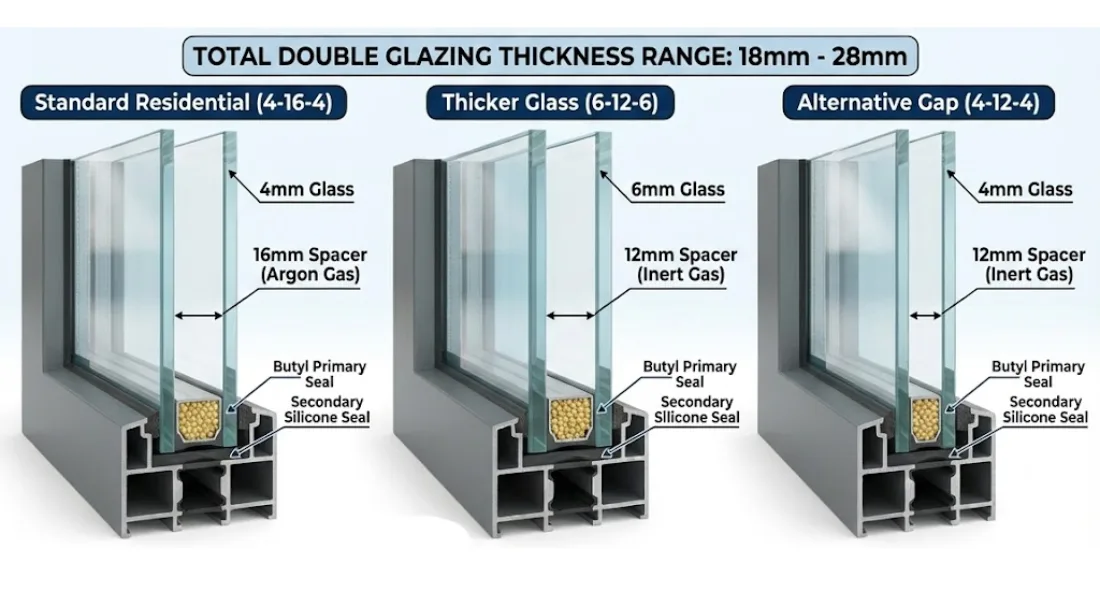
When replacing a double-pane window sash or ordering a new insulated glass unit (IGU), one of the first questions you’ll need to answer is: how thick should the glass be? The answer isn’t just one number — a double-glazed unit is made up of several layers, and each one affects performance.
The Anatomy of a Double-Glazed Unit
A standard double-glazed insulated glass unit consists of:
- Outer glass pane — typically 3mm or 4mm thick
- Spacer bar — a hollow aluminum or warm-edge spacer filled with desiccant
- Gas fill — argon or krypton between the panes
- Inner glass pane — same thickness as outer pane
- Sealant — primary and secondary butyl/silicone seal around the perimeter
Common Double Glazing Thicknesses
The most common configurations in residential use are:
| Configuration | Total Unit Thickness |
|---|---|
| 3mm / 6mm gap / 3mm | ~12mm (approx. 1/2”) |
| 3mm / 9mm gap / 3mm | ~15mm (approx. 5/8”) |
| 4mm / 12mm gap / 4mm | ~20mm (approx. 13/16”) |
| 4mm / 16mm gap / 4mm | ~24mm (approx. 15/16”) |
In the U.S., thicknesses are commonly expressed in fractions of an inch. The most popular residential IGU is 1” overall thickness, often configured as:
- 1/8” glass + 3/4” spacer/gas + 1/8” glass
- Or 3/16” glass + 5/8” spacer/gas + 3/16” glass
Why Does Glass Thickness Matter?
Structural strength: Thicker glass (3/16” or 1/4”) is better for large panes, high-wind locations, or areas where impact resistance is important.
Thermal performance: The spacer gap has more impact on thermal performance than pane thickness. A wider gas-filled cavity (up to about 16mm/5/8”) improves insulation. Beyond that, convective currents inside the gap actually reduce efficiency.
Acoustic performance: Thicker glass and asymmetric configurations (e.g., 3mm outer + 5mm inner) reduce sound transmission more effectively than symmetric thin panes.
Frame compatibility: The most critical factor for a replacement IGU is matching the thickness your existing frame was designed to hold. Installing a unit that’s too thin or too thick can compromise the seal and cause premature failure.
How to Measure Your Existing IGU
If you’re replacing a failed double-pane unit, measure the overall thickness of the unit (not just the glass) by removing the sash and measuring at the edge. This is the number your glass shop needs to fabricate an exact replacement.
At Allnite Glass, we recommend bringing the sash directly to our shop. We’ll measure precisely and fabricate a replacement IGU to the exact thickness and dimensions required — ensuring a perfect fit in your existing frame.
Specialty Thickness Applications
- Commercial storefronts: Often use 1” or 1-1/4” IGUs with thicker glass (1/4”) for structural requirements
- Hurricane/impact zones: Laminated safety glass adds thickness; units may be 1-1/2” or more
- High-security applications: Thicker glass plus lamination layers can bring total IGU thickness to 2” or more
Get the Right Glass for Your Project
Whether you need a standard residential replacement or a custom-thickness unit for a specialty application, Allnite Glass in Clarksville, TN has the equipment and inventory to fabricate it correctly. Stop by at 1525 Ashland City Rd or call (931) 645-2464 to discuss your project.

Allnite Glass Team
Expert glaziers sharing glass tips and industry insights.
Ready to Get Started?
Contact us today for a free quote on commercial glazing, custom-cut glass, window repair, and more. Most repairs completed within 24–48 hours.
Monday – Friday: 7:00 AM – 5:00 PM · Saturday – Sunday: Closed