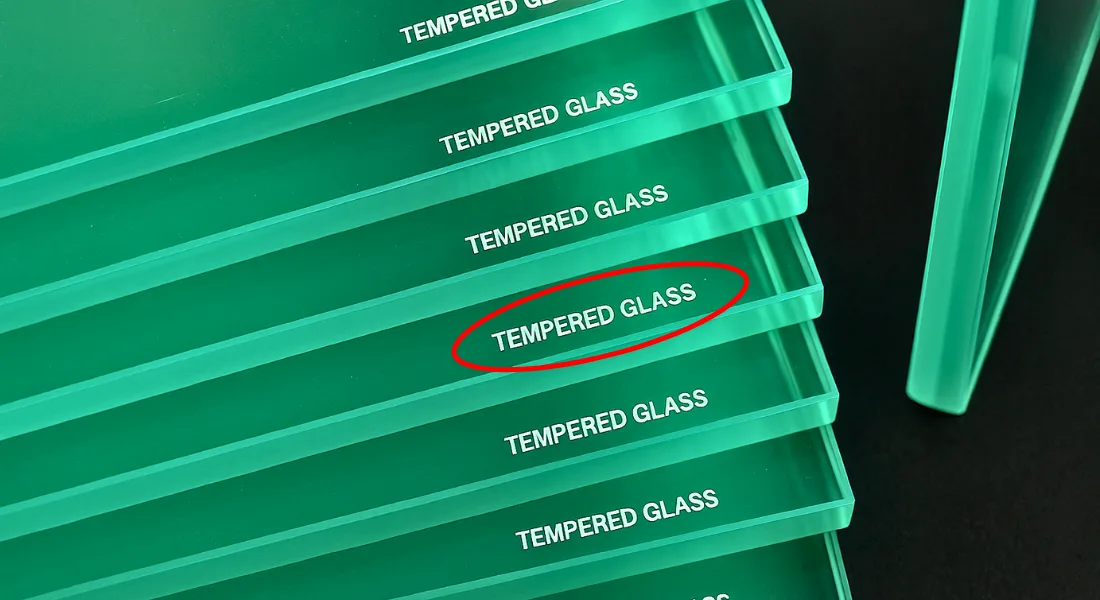
Tempered safety glass is required by code in dozens of building applications — showers, railings, entry doors, patio doors, glass near floor level. But how do you actually tell whether a piece of glass in front of you is tempered? One check carries real weight, and the rest are supporting clues.
How can you tell if glass is tempered?
The most reliable way to identify tempered glass is to look for a permanent safety-glazing mark or stamp near a corner of the pane. Polarized-light patterns, edge appearance and iridescence can provide clues, but they should not be treated as definitive proof on their own.
Check the Tempered Glass Stamp or Safety Mark First
This is the check that actually settles the question. Properly manufactured tempered glass sold in the United States is permanently marked with a safety-glazing certification stamp — typically etched, sandblasted or ceramic-fired into a corner of the pane.
A legitimate safety glazing mark includes:
- The manufacturer’s or fabricator’s name or trademark
- A designation code naming the standard met (ANSI Z97.1 or CPSC 16 CFR 1201)
- The type of safety glazing (commonly “T” for tempered or “L” for laminated)
- A category or classification indicating tested performance
Where to look: any corner, most often the bottom. On monolithic tempered panels the mark is etched directly into the glass surface. In an insulated glass unit it may sit on the spacer bar instead, which can make it harder to see once the unit is installed in a frame.
If the glass carries no safety-glazing mark, you cannot confirm it is tempered by looking at it. Note too that the mark identifies the pane as safety glazing, which is a broader category than tempering — see how tempered glass fits into the safety glazing category for what else can carry that designation.
Look Through Polarized Sunglasses for Stress Patterns
This is the field trick people reach for most often, and it is worth understanding what it does and does not show.
- Put on polarized sunglasses, or hold polarized lens material up to the glass
- Look at the pane at an angle to a source of reflected light — the sky, or a bright window
- Watch for a pattern of light and dark bands or spots across the surface
That pattern comes from the internal stress distribution left by heat treatment, which creates localized birefringence. Annealed glass does not carry those stresses and tends to look uniform.
Treat the result as a clue, not a verdict. Polarized lenses may reveal stress patterns associated with heat-treated glass, but this should be treated as a supporting clue rather than proof that a pane is certified tempered safety glass. The pattern is subtle, depends heavily on light and viewing angle, and is easy for an untrained eye to miss or to imagine.
Watch for Faint Iridescence
Tempered glass sometimes shows a faint iridescence — a rainbow-like shimmer — when viewed at certain angles in strong natural or artificial light. This is the same internal stress pattern made visible by the wave properties of light.
It is less reliable than the polarized-lens check and harder to read, so it belongs at the bottom of the list of clues rather than anywhere near a conclusion.
Check the Edges
When the edges are visible rather than hidden in a frame, they can offer a supporting indicator:
- Edges may show faint wave patterns left by the tempering furnace
- Edges are typically polished smooth or carry a machine seam, because tempered glass must have all edgework finished before heat treatment
- The edges may look slightly different in color or texture from annealed glass
None of this is definitive on its own. It is context that supports or undercuts what the mark tells you.
What to Do If You Can’t Verify
If you are buying glass for a safety-critical application — a shower enclosure, a railing, a door — and cannot verify that it is tempered:
- Buy from a reputable supplier who can provide the manufacturer’s documentation for the specific panel
- Order through a glass shop that can supply correctly specified and labeled safety glazing for the application
- Don’t install unverified glass in a hazardous location — the liability and the safety risk are both real
Allnite Glass can help identify project requirements and obtain correctly specified tempered glass for residential and commercial applications. If you are unsure whether existing glass is tempered, contact our Clarksville glass shop with photos of the pane and any visible markings. You can also call (931) 645-2464 or visit 1525 Ashland City Rd, Clarksville, TN.

Expert glaziers sharing glass tips and industry insights.
Ready to Discuss Your Glass Project?
Tell Allnite Glass what you need, where the project is located, and whether the glass can be brought to the Clarksville shop. The team will confirm scope, availability and next steps.
Monday – Friday: 7:00 AM – 5:00 PM · Saturday – Sunday: Closed